
Below is a guide on how to measure common types of springs, suitable for engineering, purchasing, or replacement purposes.
Before measuring any spring:
- Measure in a relaxed state
- Use callipers, rulers alone are not accurate enough
- Record measurements in millimetres (mm)
- Avoid stretching or compressing the spring during measurement
- Count active coils only (Count the number of 360 revolutions that are separated by a space and not touching)
Compression Springs
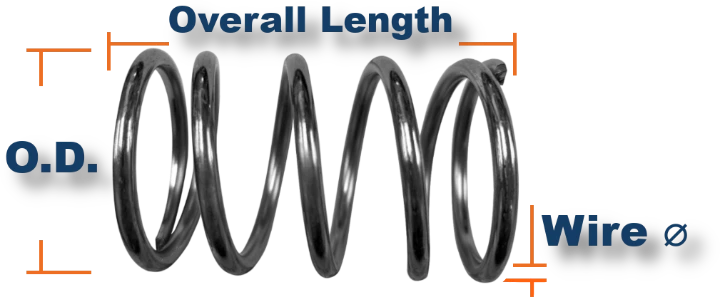
How to Measure
Free Length / Overall Length
- Measure overall length from end to end with no load applied.
Outside Diameter (OD)
- Measure across the widest point of the coils.
Wire Diameter
- Measure wire thickness using callipers.
Inside Diameter (ID)
- Calculate from OD and wire diameter.
Number of Active Coils
- Count only coils that deflect under load. (Count the number of 360 revolutions that are separated by a space and not touching)
End Type
Note whether ends are:
- Closed
- Open
- Ground
- Closed and ground
Optional (if required):
- Spring rate (N/mm) measured using compression force testing equipment.
Tension / Extension Springs
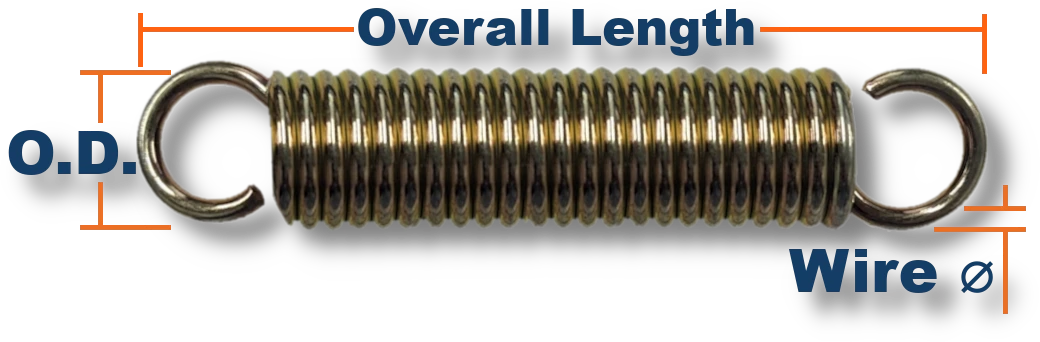
How to Measure
Free Length
- Measure from inside face of one hook to inside face of the other, with no load.
Body Length
- Measure the coil-only section, excluding hooks.
Wire Diameter
- Measure one coil with callipers.
Outside Diameter (OD)
- Measure across coils along the main body, excluding hooks.
Hook Style and Orientation
Identify:
- Machine hook
- Crossover hook
- Extended hook
- Hook angle and direction
Optional:
- Initial tension (requires force test equipment)
Torsion Springs
Torsion springs store energy by twisting.
How to Measure
Inside Diameter (ID)
- Measure the internal coil diameter directly.
Wire Diameter
- Measure wire thickness with callipers.
Leg Lengths
- Measure each leg from coil centreline to leg end.
Leg Orientation
- Clockwise or counter‑clockwise
- Measure the angle between legs (degrees)
Number of Coils
- Count total coils (torsion springs typically use all coils).
Optional:
- Torque rate (Nm/degree) using a torsion test rig.
Measurement Tips
- If tolerances are tight and / or copying an existing spring, feel free to send a sample to our listed address Contact Us
- Measure multiple points and average if tolerances are tight
- Take photos of springs with labels or orientation notes
record:
- Application
- Operating load
- Travel distance
Direct sales email contact:
accounts@tensionworks.com.au